CAIO Weeknote #32
Inspiration, Connections and Debate on Smarter State

Monday
9am Team Kick off Meeting sets us up for the week.
AI Programme Strategy is always planned and sometimes team spill over or 121 meetings often happen to move separate agenda’s forward.
Preparing for Junior Project Managers interviews later in the week.
Monthly 1 hour 121 with Henry who runs our AI in Education Programme, helping to give feedback on his strong ideas and add value where I can to steer the direction of opportunities. Had to cut it 10 mins short to grab a super quick lunch I could make and eat in 10 mins. I need to make my diary more defensible whilst we are campaigning for more resources.
Meeting with our Control Team and suppliers to discuss the technical infrastructure and what is needed by whom when for our forthcoming planning on Proof of Concept.
Meeting with many key stakeholders convened by the University of Liverpool investigating how we can create a sandbox that looks at emerging tech regulation for digital health care solutions.
AI Task Force final recommendations submitted to the Mayor’s Office.
Tuesday
Engaging conversation with local provider, Seline, who is currently running our Youth Combined Authority, to understand key points of future engagement.
Financial admin and documentation on procurement.
Monthly 121 with Kayla who leads on AI in Transport, completing annual objective setting.
Preparation for my Panel discussion at Tech UK tomorrow. Enough preparation between meetings to help me understand I need more preparation.
Weekly meeting with Kayla to drive AI in Transport ahead.
Step back into financial admin, enough to realise I need to take more than half a day to complete what is needed. Have tentatively held time this week.
Leading interviews for the Junior Project Manager we are hiring in our team.
Team meeting with Lorna and I and external partners to help us define our Smarter Place vision and strategy.
Call with my Uni lecturers to try to fathom why on earth the Student Loans Company has taken repayment direct from my salary a YEAR EARLY. I’ve not officially finished this term, so it was a surprise to say the least.
Wednesday
Super long day as the only time I could stand aside to properly prep for my panel at Tech UK today was 5-7 am this morning with a clear head and no interruptions.
A huge thank you and congratulations to techUK for one of the best events on my calendar on Smarter State 2026, easily in my Top 5 conferences I have attended for my role since being in post in Sept 2025.
Great to hear from James Frith, MP, PUS for DSIT, share on Digital ID ahead of the King’s Speech. Great to note it will be optional, and there's a huge plan for the digitally excluded to get on board.
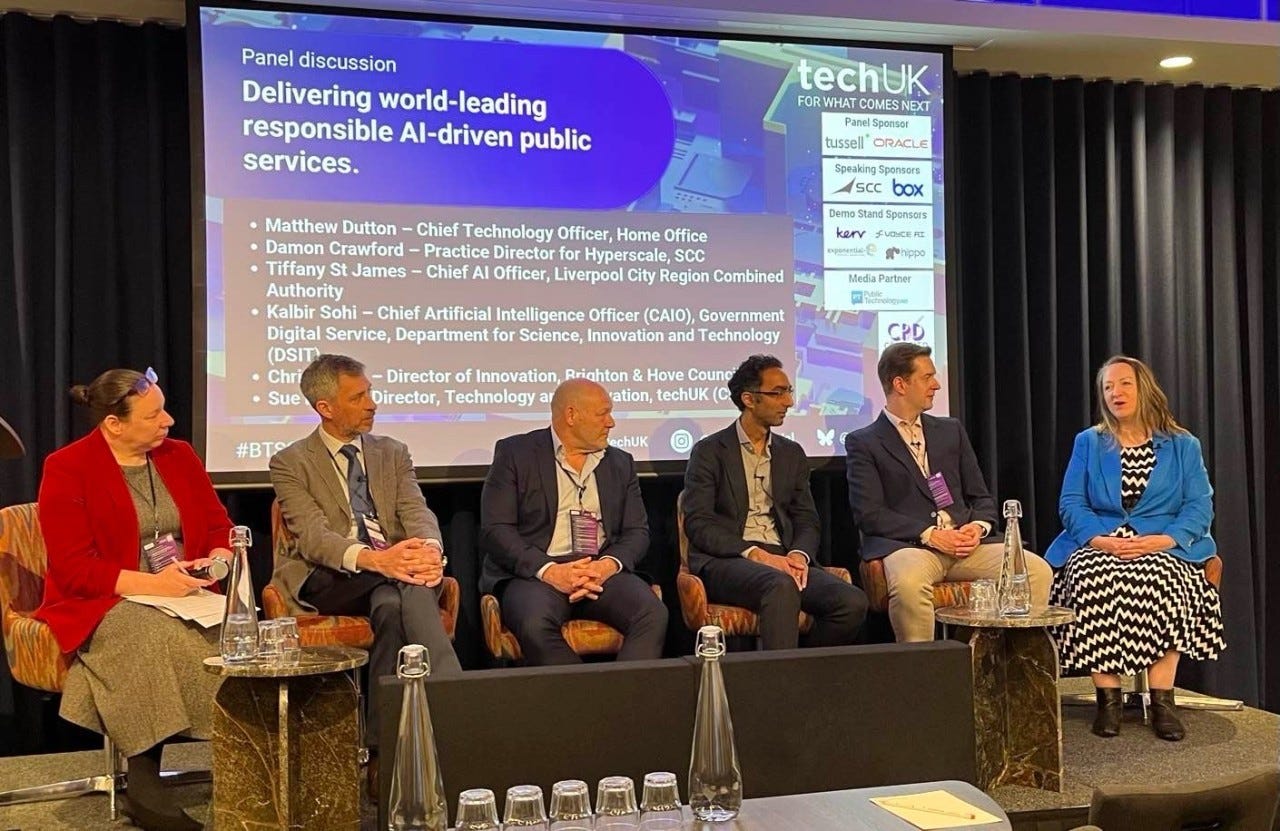
Thoroughly enjoyed my panel debate on 'Delivering world-leading responsible AI-driven public services with:
Kalbir Sohi, GDS, CAIO in DSIT
Matthew Dutton, CTO Home Office
Chris Wales, Dir of Innovation, Brighton and Hove Council
Damon Crawford, Practice Director at SCC
I will pick up with Matthew on shared procurement frameworks, collaborate with Kalbir on Education and Health and Social Care initiatives, check in with Chris on how we can better enable innovation through taking risks, and ever grateful to Damon who's closing take away is that 'everyone should have a Tiffany’ :) - on my extolling of leadership psychology underpinning the conditions for innovation in the age of AI.
I was gripped by the innovations shared by:
Sidsel Bülow Skovborg in Denmark
Murtaza Masood in running Los Angeles and sharing other California AI and data management
A huge privilege to meet Aiko Hayama and Daishi NAKAMURA from GovTech Tokyo and hear Tokyo's management.
The closing speech from the Minister of Justice and Digital Affairs, Republic of Estonia, on why Justice and Digital is one portfolio and how they are organised was an inspiration for us all.
Great to see Omid Shiraji, Nigel Jones, Liz Cook and Joanna Birch again and know that Madeline Hoskin, leading tech in North Yorkshire Council, and I are going to cause good trouble together in the North.
A huge thank you to Georgina Maratheftis, Sue Daley OBE and all the Team at Tech UK. #BTSS2026
Here are my panel questions and the answers I prepped and (mostly) got across.
What skills and capabilities do public sector organisations (and their people) most need to successfully adopt AI into public service delivery, and how are you building a culture that empowers teams to innovate safely and confidently?
Culture: To enable people to take risks you need Psychological Safety. Even teams with PS sometimes tank unless they have one other component, the ability to have Constructive Dissent, to be able to say to Leaders they are wrong and improve practice. The enabler of that is setting the right conditions for Employee Voice – enabling people who are closest to the action to speak up appropriately and ethically.
Where do partnerships with industry (and academia?) add the most value in delivering responsible AI, and is there anything government could be doing differently to make these collaborations more effective?
Quadruple Helix: CA, Academia, Businesses and Civil Society
LCR have a Data and AI Resident’s Charter convened by residents opinion on how their data is treated.
Central government needs to co-design frameworks with places. The AI Opportunities Action Plan is largely a central government document. I’m asked to deliver responsible AI within communities that have real complexity: deprivation, legacy infrastructure, yet the policy scaffolding mostly assumes a departmental context. It doesn’t treat local and combined authorities as delivery partners for responsible AI in public services. The “AI in public services” agenda in the plan is almost entirely framed around central departments.
FIX Procurement: UK public-sector AI is bought through frameworks designed for stable, definable IT goods and services. This fundamentally doesn’t work for AI, where models change every six months and the supplier landscape is shifting rapidly. Industry partners want to collaborate meaningfully, but the procurement routes make it nearly impossible to build the iterative, trust-based relationships responsible AI actually requires. Central government needs a local government-specific AI procurement framework, the Ada Lovelace Institute called for a national taskforce on exactly this.
Share the infrastructure: national data infrastructure like the National Data Library initiatives aren’t designed for two-way flows, it needs to build data infrastructure that local government can actually participate in, not just consume from.
Central government has built a lot of governance architecture for AI, but the gap between governance scaffolding and project-level discipline remains wide. What places need is procurement reform, shared infrastructure, capability investment, and genuine co-design. Industry and academia can add enormous value in responsible AI delivery, but only if central government creates the conditions for those partnerships to be more than one-off pilots.
How are public sector organisations facilitating knowledge exchange and learning from each other? Are there areas where this can be improved?
At LCR we are learning from international peers and partnerships
KUDATA — Korea-UK Digital Twin Approach for Transport Analysis collab between LCR, UoL, and partners in Busan, using AI to model our entire transport network virtually before making real-world changes, we’re co-developing it with an international peer city.
Hamburg MOU via ARIC Artificial Intelligence Centre Hamburg, Landmark agreement to develop a trans‑European AI supercluster, sharing expertise and accelerating real-world applications of advanced tech including Quantum Technologies
Chattanooga - punches way above its weight (municipal broadband, smart city infrastructure) and shows what a mid-sized post-industrial city can do when it treats digital infrastructure as public infrastructure.
What would improvement look like: Teams working on AI in transport, health, and digital twins are solving overlapping problems (data quality, model governance, public trust, procurement) in complete isolation from each other. We need live cross-city working groups.
What do you see as the most significant risks associated with deploying AI in public services, such as bias, misuse in data, automation error or loss of public trust, and how are you actively mitigating and governing these risks in live services.
Bias and automation error are real, but they’re knowable, you can test for them, audit them, iterate. The key risk is loss of public trust
Data misuse: the governance question isn’t just is the data secure, it’s “would the public recognise the use we’re putting it to as legitimate?” That’s a higher bar than compliance, and it’s the bar we should be holding ourselves to.
How do you navigate the opposing challenges of using citizen data and sharing data across services to build innovative services versus protecting the privacy of that data?
Privacy and data sharing aren’t opposites
Citizens broadly want better public services. They’re often willing for their data to be used, what they’re not willing for is to be surprised by it.
Legitimate purpose, not maximum use. Just because we can combine datasets doesn’t mean we should. Every data sharing decision has to answer: would the person whose data this is recognise this use as reasonable?
Privacy by design, not privacy by compliance.
GDPR is the floor, not the ceiling.
A privacy notice nobody reads isn’t consent. Genuine engagement with communities about how their data is used, is part of responsible AI, not separate from it.
Data that stays siloed to protect privacy also fails people. The person who falls through the gap between health and social care because those systems don’t talk to each other, that’s also a harm. So, the question is whether your governance is mature enough to earn the right to share.
If we were to reconvene in two or three years’ time, what would success look like for responsible AI-driven public services. And what needs to happen now to get us there.
Boring, seamless, invisible AI
A young person who didn’t fall through the gap between services because the data joined up in time.
A bus network that adapted around the people who needed it most.
A resident who got a faster planning decision.
A carer who got a timely referral.
The measure isn’t deployment it’s whether people’s lives are measurably better, and whether they trust the system that helped deliver it.
Thursday
I’d like to say I used the time well that I put aside for finance reconciliation, but I was sidelined by emails from yesterday and making the most of yesterday’s connections.
Preparation for, and delivery of, interviews for our new Junior Project Manager.
Useful 30 mins with my Director, Lorna, for a quick steer on AI Task Force.
Team appraisal with Henry from my team.
Friday
What is the collective noun for back-to-back 30 minute meetings until mid-afternoon? A gridlock of.. A marathon of..
8am kick off to continue to pick up all the brilliant connections and collaborations from the Tech UK event and still not going to get them in all this week.
Prep for AI Summit meeting later.
A chat with LCR colleague John on our Industrial Strategy Zones.
Prep for a supplier call who we want to partner with on research and governance.
Call with the team on the appointment of our JPM to share points of view.
Call with Jim Rawton, exceptional mind and provocateur for good, Director of Impeller who I’d met when he spoke on the Novel Programme. Jim lives dangerously close to me and I know I could easily lose a few Saturdays in coffee and the state of innovation.
Catch up with Izzy supporting our team and her brilliant work on AI Test Bed research.
Supplier call on the research and governance we want to commission to help the AI Programme.
Gathering of attendee emails and wicked problems to share with partners producing our Smart Space strategy workshop.
Prep for our monthly AI Summit Meeting.
Monthly AI Summit Meeting.
Catch up with Mischa supporting our team on processing actions from the meeting.
A brilliant week, stuffed full of inspiration and connections, too full of admin and still never enough time. I’ll be on holiday from Tuesday so no Weeknote next week. Should the weather and wind be kind I’ll be sailing to the Channel Islands and back, not exactly a restful break, but jam-packed full of big skies and overnight sailing to clear the cobwebs and give a sense of perspective.
Events that I’m speaking at - coming up
16-17 June: Global AI Cities 2026, Manchester
10 Sept: Connected Britain, London
10 Nov: Brilliant Festival, Liverpool
Tiffany St James
Chief AI Officer, Liverpool City Region Combined Authority